
CRISPR
Leading Future Bio-Innovation Through Precision Gene Editing From R&D to Commercial Therapeutics and Agriculture.
CRISPR-Cas9
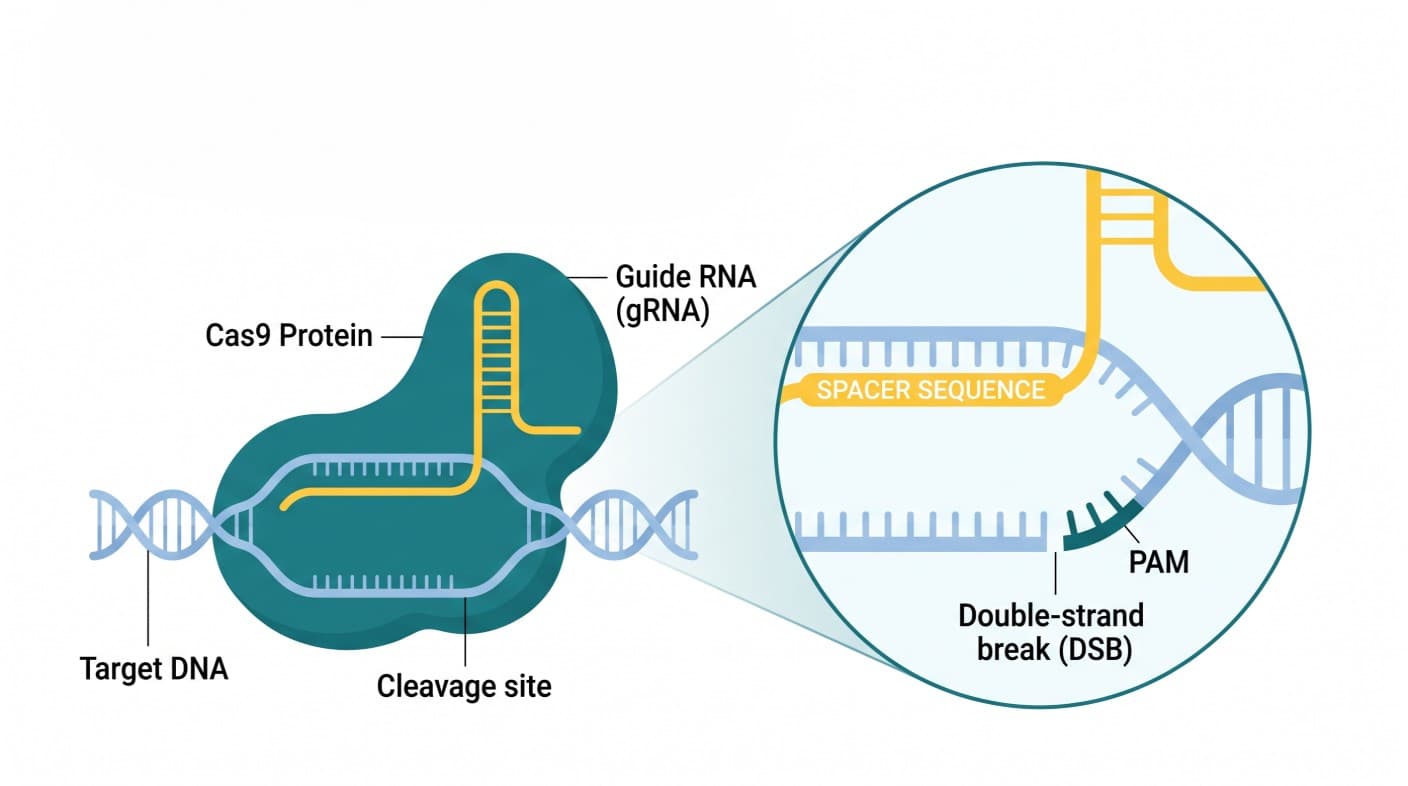
CRISPR-Cas9 is a third-generation gene-editing technology that succeeded the first-generation ZFNs and the second-generation TALENs. It has ushered in a new era for the biotechnology industry.
Recognised for its exceptional targeting precision and streamlined design compared to traditional methods, it has been widely adopted as a core technology by leading research institutions and major biotech companies around the world.
+ Read more− Close
Extended Research
CRISPR-Cas9 technology has achieved unprecedented success in gene editing. Follow-up research has led to the development of many new CRISPR-based tools, such as base editors and prime editors. Depending on the specific purpose, these Cas9-based applications can significantly facilitate gene editing. Because these tools are Cas9-based, the original CRISPR-Cas9 patent is of great importance. ToolGen is currently conducting various R&D activities to expand its portfolio of core technologies.
Gene editing tools based on Cas9 other than Cpf1 and Sp. Cas9, have been shown to target fewer sites and, for the most part, exhibit lower efficiency compared to Sp. Cas9. However, Sp. Cas9 has the drawback of exhibiting a higher off-target editing rate due to the side effects associated with a large number of targets and high efficiency. Cas9 has the drawback of a higher off-target editing rate than these new tools. Recently, ToolGen addressed this limitation by developing Sniper2L, a mutant form of Sp. Cas9, which dramatically reduces the off-target editing rate while maintaining high efficiency.
Sp. Cas9 plays a pivotal role in new tools, such as base editors and prime editors, and can perform a wide range of functions. For instance, base editors and prime editors are highly effective at modifying specific DNA bases, but their scope of application is limited. In contrast, Sp. Cas9 can be used for various applications, including gene knockouts, knock-ins, large deletions, CRISPRi, and CRISPRa. Furthermore, Sp. Cas9 has a broader range of target sequences than Cpf1. Cpf1 has a TTTV PAM sequence, resulting in a much more limited range of target sequences than Sp. Cas9, which has an NGG PAM sequence. Additionally, Sp. Cas9 has been studied more extensively than any other new tool. A vast amount of research literature has been published across various fields, covering topics such as the mechanism of action of Sp. Cas9, its side effects, and differences in efficiency when using various delivery tools.
While CRISPR gene editing tools such as Cpf1, base editors, and prime editors are being developed, Cas9 remains the most powerful and versatile gene editing tool thanks to its high efficacy, diverse applications, broad target sequence range, and extensive body of literature. As the field of gene editing evolves, new tools will likely emerge. However, the proven efficacy and versatility of Sp. Cas9 is expected to keep it at the forefront of gene editing research for years to come.
Sniper 2L
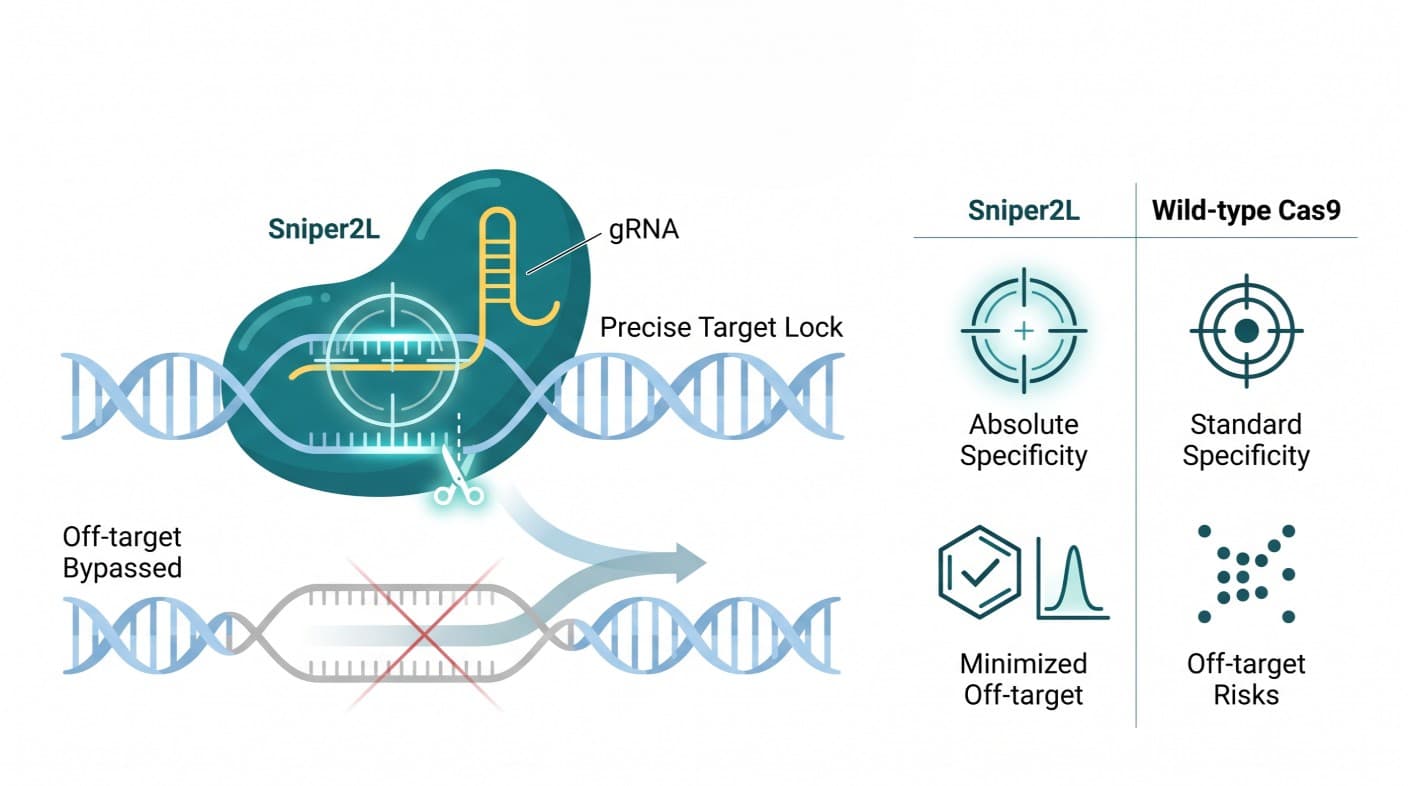
Sniper 2L is the next generation of Sp. Cas9, which innovatively overcomes the only limitation of this powerful and versatile enzyme: high off-target effects.
While maintaining the exceptional on-target efficiency and broad targeting range of the original Sp. Cas9, Sniper 2L dramatically minimises unwanted off-target mutations, enabling highly precise and extraordinarily safe gene editing.
+ Read more− Close
Extended Research
Sp. Cas9 technology has become the standard in gene editing. Follow-up research aimed at maximizing its safety for real-world industrial applications, such as clinical-stage gene therapies and precision agriculture, is being actively conducted. Controlling off-target side effects in gene editing has become essential for commercialization amid this trend, and ToolGen has been conducting various R&D activities to secure next-generation core technologies that surpass the limitations of existing Sp. Cas9 technology. The result of these efforts is Sniper 2L, ultra-precise gene scissors.
While previous high-fidelity Cas9 variants have had some success in reducing off-target effects, they have a critical drawback: their on-target editing efficiency is significantly lower than that of wild-type Sp. Cas9. Conversely, existing Sp. Cas9 boasts high efficiency but carries a relatively high risk of inducing mutations at off-target sites. Recently, however, ToolGen has overcome this trade-off through protein engineering optimization. By developing the Sniper 2L variant, which maintains powerful editing efficiency at the wild-type level while dramatically reducing off-target editing efficiency, ToolGen has resolved the safety challenges associated with gene scissors.
Not only is Sniper 2L valuable as a standalone gene-editing enzyme, but it can also play a far more versatile role as a component of new tools, such as base editors and prime editors. For instance, replacing the core of existing base or prime editor systems with Sniper 2L can significantly reduce their inherent off-target risk, upgrading them into highly precise, safe tools. Furthermore, Sniper 2L recognizes the same NGG PAM (protospacer adjacent motif) sequence as conventional Cas9. Cas9, Sniper 2L has a broad range of target sequences. This means it can be directly substituted for a wide range of applications where Sp. Cas9 was previously used, such as for gene knockouts, knock-ins, and large deletions. It offers the tremendous advantage of leveraging the vast body of research literature and diverse delivery tool data accumulated for Sp. Cas9.
While new precision gene editing tools are continually being developed to reduce off-target effects, Sniper 2L has secured an overwhelming advantage as a powerful and versatile tool for precision gene editing. This is thanks to its high on-target efficacy, low off-target safety, perfect compatibility with existing platforms, and broad scalability. As the field of gene editing advances toward clinical applications and commercialization, “safety” will be the most critical evaluation criterion. With its proven efficacy and innovative precision, Sniper 2L is poised to be at the forefront of gene therapy and precision medicine research for years to come.
CRISPR RNP
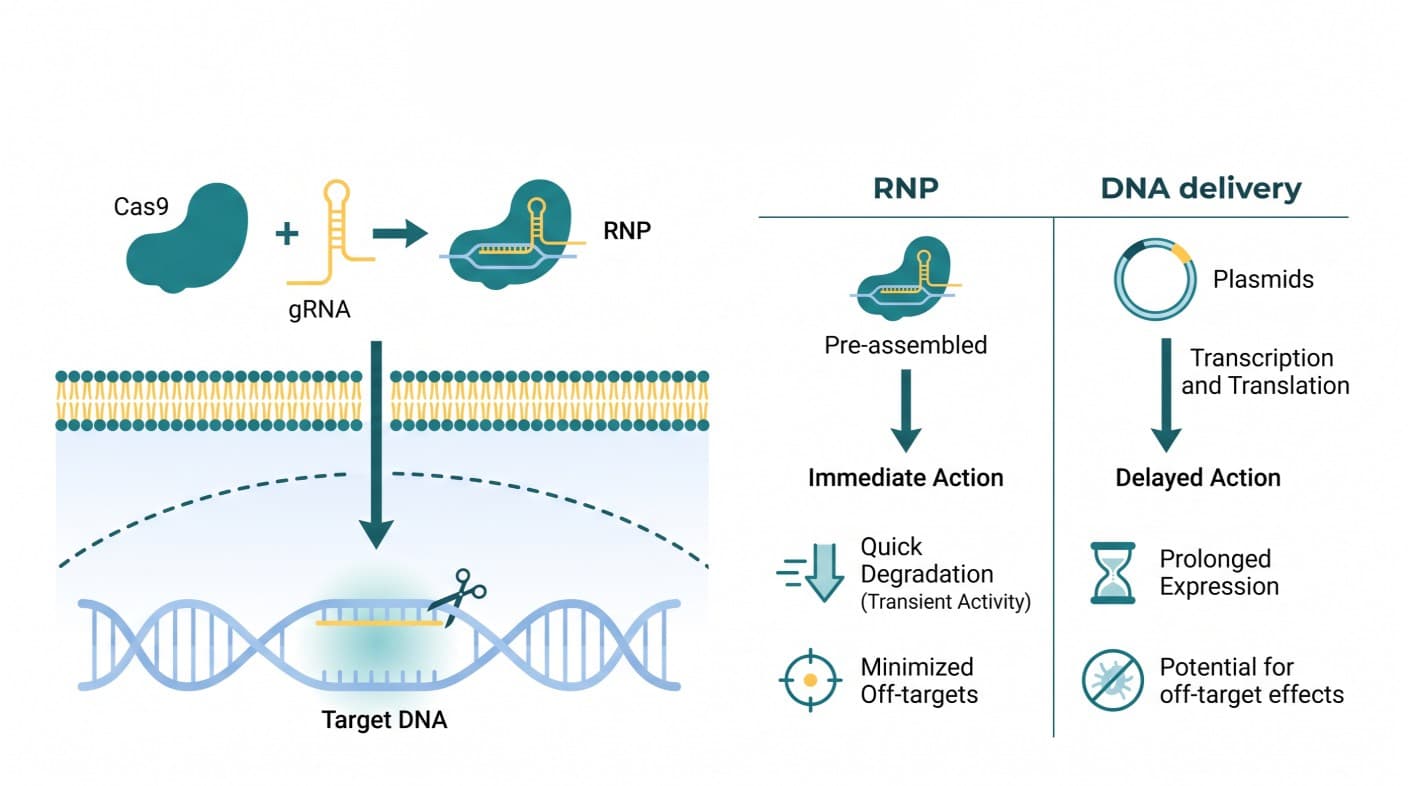
CRISPR RNP platform is a fully assembled enzyme complex designed to deliver the innovative CRISPR-Cas9 system into cells with maximum safety and efficiency.
This approach overcomes the inherent limitations of traditional delivery methods utilizing plasmid DNA or viral vectors by introducing the Cas9 nuclease and the target-guiding RNA as a pre-assembled complex in vitro.
+ Read more− Close
Extended Research
CRISPR-Cas9 system has become a key tool in gene editing, research on how to safely and efficiently deliver it to cells has become a critical issue in the commercialization of gene editing technology. While early gene editing research relied on plasmid DNA or viral vectors, the direct delivery of RNP (ribonucleoprotein), which consists of Cas9 protein and guide RNA (sgRNA) that are pre-combined outside the cell, is becoming the next standard. The RNP delivery platform can maximize the accuracy and safety of gene editing, making it a necessary technology for applications such as drug development and seed improvement.
However, DNA or viral vector delivery methods induce long-term expression of the gene scissors in the cell, resulting in high correction efficiency but also increasing the likelihood of off-target effects. Additionally, there is a risk of external DNA being randomly inserted into the host cell’s genome (insertional mutagenesis). In contrast, CRISPR RNP immediately edits the target gene after being introduced into the cell and is quickly broken down by cellular enzymes within a few days. This “hit-and-run” mechanism prevents malfunction and significantly reduces off-target editing. In particular, when the high-efficiency, high-precision mutation enzyme “Sniper2L” developed by ToolGen is applied in RNP form, the enzyme’s precision and the delivery method’s safety interact to virtually eliminate off-target issues.
CRISPR RNP is especially effective in high-level tasks that were previously difficult to access. For example, when developing next-generation immunotherapies such as CAR-T cell therapy, primary cells or stem cells are often used. However, when external DNA is introduced, these cells often die due to strong toxicity and immune responses. However, the protein-RNA complex RNP does not cause DNA toxicity, thereby maximizing cell survival. Additionally, the combination of single-stranded DNA (ssODN) and RNP can significantly increase the efficiency of precise gene insertion (knock-in), which is essential for the treatment of genetic diseases. In the agricultural field, the RNP method is advantageous because it is a “DNA-free” process, meaning that no foreign DNA remains in the final product. This gives it an absolute advantage in avoiding or receiving relaxed GMO (genetically modified organism) regulations.